As we’ve wrapped up reviewing initial HTMA results from women inside the Mineral Healing Journey program, certain patterns have started to repeat themselves.
Many of these women came into the program feeling like their body had slowly started working against them. They were already putting effort into their health. They were eating well, trying to exercise consistently, and making thoughtful choices around their lifestyle.
Yet their body still felt stuck.
Energy was low. Cycles felt irregular or unpredictable. Weight felt resistant despite their efforts. And workouts that used to feel energizing were suddenly leaving them completely drained.
When we look deeper through mineral testing, we often find that the issue isn’t a lack of effort or motivation. Instead, there is a mineral and metabolic pattern that has been developing beneath the surface.
One pattern we’ve seen repeatedly in the Mineral Healing Journey so far looks like this:
• slow metabolic type
• low sodium and potassium
• signs of sluggish adrenal activity
• copper dysregulation
• patterns that reflect low vitality and reduced metabolic output
When these pieces show up together, the body often shifts into a more energy-conserving state where resilience, metabolic flexibility, and hormone balance become much harder to maintain.
Two of the minerals we pay especially close attention to on HTMA are sodium and potassium. These minerals give us valuable insight into adrenal activity and the body’s ability to generate and regulate energy throughout the day.
When sodium and potassium are low, it can reflect reduced adrenal output and diminished metabolic activity. In simple terms, the body has been under stress for long enough that it begins conserving energy rather than producing it efficiently.
Women in this pattern often describe feeling like their energy never fully comes back, even after rest. They may feel wired but tired, struggle with brain fog, or notice that their motivation and stamina have slowly declined.
Common symptoms that tend to show up alongside low sodium and potassium include:
• persistent fatigue
• unstable blood sugar
• difficulty tolerating exercise
• feeling depleted even after sleep
• brain fog and low motivation
One of the most noticeable changes many women describe is their relationship with exercise. Workouts that once helped them feel stronger and more energized begin leaving them exhausted, and recovery becomes slower and more difficult.
This is often one of the body’s early signals that metabolic reserves are running low.
This mineral pattern can also influence thyroid function in ways that traditional lab testing doesn’t always capture.
The thyroid works closely with the adrenal glands and the body’s overall metabolic environment. When mineral reserves become depleted and stress remains high for long periods of time, thyroid hormone activity can begin to shift.
The body may convert less T4 into active T3, cells may become less responsive to thyroid hormone, and metabolism can slow as the body shifts into a more protective state.
This is why many women experience symptoms commonly associated with thyroid dysfunction even when their labs fall within the conventional “normal” range.
Symptoms such as fatigue, cold intolerance, weight loss resistance, dry skin, constipation, and hair changes often reflect deeper metabolic stress rather than a thyroid problem in isolation.
The thyroid frequently mirrors what is happening throughout the rest of the metabolic system.
Another layer we frequently see in this pattern inside the Mineral Healing Journey is copper dysregulation.
Copper is an essential mineral involved in energy production, hormone balance, and iron metabolism. However, when copper is not properly bound and transported in the body, it can begin to contribute to hormonal and metabolic disruption.
This pattern often shows up in women with histories of hormonal birth control use, chronic stress, digestive dysfunction, or impaired liver and bile flow.
When copper becomes dysregulated, it can contribute to symptoms such as:
• cycle irregularities
• estrogen dominance symptoms
• mood swings or anxiety
• histamine sensitivity
• skin issues
• persistent fatigue
Many women in this pattern describe feeling both overstimulated and exhausted at the same time. Their nervous system feels activated, yet their energy levels remain low.
When copper dysregulation overlaps with adrenal depletion, it can create a confusing mix of symptoms that often gets overlooked in traditional testing.
When someone is in a slow metabolic pattern with low adrenal output and mineral imbalances, the body often shifts into a more protective metabolic state.
Rather than prioritizing growth, repair, and metabolic flexibility, the body begins conserving energy in response to prolonged stress.
In this state, metabolic rate may slow, exercise recovery becomes more difficult, and the nervous system may remain in a heightened stress response.
This is why pushing harder with exercise or restricting calories often backfires for women in this pattern. Instead of improving metabolism, these strategies can deepen the sense of exhaustion and stress.
Many women feel like they are doing everything right, yet their body simply isn’t responding the way it used to.
This is exactly why mineral testing is such an important part of the Mineral Healing Journey program.
Every participant completes a Hair Tissue Mineral Analysis so we can understand her unique mineral patterns, metabolic type, and the deeper story her minerals are telling.
From there, we create custom mineral blends based on her HTMA results, health history, symptoms, and primary concerns.
Even though this slow metabolic pattern with low sodium, potassium, and copper dysregulation is something we’ve already seen show up repeatedly in the program, no two HTMA tests are ever exactly the same.
This means we are not simply addressing one pattern or applying the same protocol to everyone. Instead, we meet each woman where she is and support the specific minerals and systems her body needs most.
Over time, as mineral balance improves and the body becomes more nourished and resilient, many women begin noticing shifts in their energy, metabolism, cycles, and their ability to tolerate exercise again.
This pattern often shows up in women who are incredibly driven.
They are productive, capable, and used to operating at a fast pace. Their schedules tend to stay full, their responsibilities are significant, and they are often the person others rely on to keep things moving.
Many of these women are balancing work (both inside and outside the home), managing families, maintaining busy schedules, and still finding time to exercise or pursue personal goals
They are not the type of women who easily slow down.
In fact, many of them feel most comfortable when they are busy and engaged.
When we talk with women who fall into this pattern, they often describe things like:
• having a hard time relaxing
• feeling restless when they are not being productive
• pushing themselves through fatigue
• gravitating toward intense workouts or packed schedules
• feeling wired even when they are physically tired
From the outside, these women often appear to handle stress extremely well. They are capable, organized, and highly productive.
Because of this, they are often told things like:
“You’re just doing too much.”
“You need to slow down.”
“You should manage your stress better.”
But when we look deeper through Hair Tissue Mineral Analysis, we often see a much more specific physiological pattern behind the scenes.
In many of these women, we see a mineral pattern that looks something like this:
• Potassium elevated above sodium
• Sodium trending lower relative to potassium
• Calcium and magnesium often trending lower
• Mineral reserves gradually declining over time
This pattern is commonly associated with what we call a Fast 1 metabolic pattern.
Rather than reflecting a body that is “doing something wrong,” it reflects a body that has been operating in an extended stress response for a long period of time.
Minerals play a major role in how the nervous system responds to stress. When potassium begins rising above sodium on an HTMA, it can indicate that the body is actively responding to stress signals and remaining in a more activated state. In this situation, stress hormones and inflammatory signaling may stay elevated longer than they should.
Instead of smoothly moving in and out of stress states throughout the day, the body remains partially switched “on.”
Many women in this pattern feel like they handle stress well because they have adapted to functioning in this state. They are used to being productive, moving quickly, and maintaining a high level of output.
But underneath the surface, the body is working very hard to sustain that pace.
Over time, maintaining this level of activity and stress signaling can begin using up mineral reserves faster than they can be replaced.
As mineral reserves gradually decline, women in this pattern may start noticing symptoms such as:
• feeling wired but tired
• difficulty relaxing even when they want to
• trouble falling asleep or staying asleep
• increasing inflammation
• cycles becoming less predictable
• ovulation becoming weaker
• energy feeling more inconsistent than it used to
Often, these symptoms develop slowly over time.
Many women initially feel like they are simply pushing through a demanding season of life. But as months or years pass, the body may begin showing signs that it is working harder than it should to keep up.
Minerals are deeply involved in the body’s stress response, nervous system signaling, and hormone regulation. They help regulate electrolyte balance, support adrenal hormone signaling, influence inflammatory pathways, and play a role in energy production within the mitochondria.
When the body remains in a prolonged stress response, it can begin using up these minerals faster than they are replaced through food alone.
Over time, this can gradually shift the body toward more depleted mineral patterns if the cycle continues.
One important thing to understand is that there is nothing “bad” about any HTMA pattern.
These patterns simply give us insight into how the body has been adapting to life’s demands.
When we see this pattern, the goal is not to suddenly remove everything from someone’s life that creates stress or productivity.
Instead, we focus on rebuilding mineral reserves and supporting the nervous system so that the body can move more easily in and out of stress states again.
As mineral reserves improve, many women begin noticing changes such as:
• more stable energy throughout the day
• improved sleep quality
• greater resilience to stress
• more consistent cycles and hormone balance
Over time, the body begins functioning with much less strain.
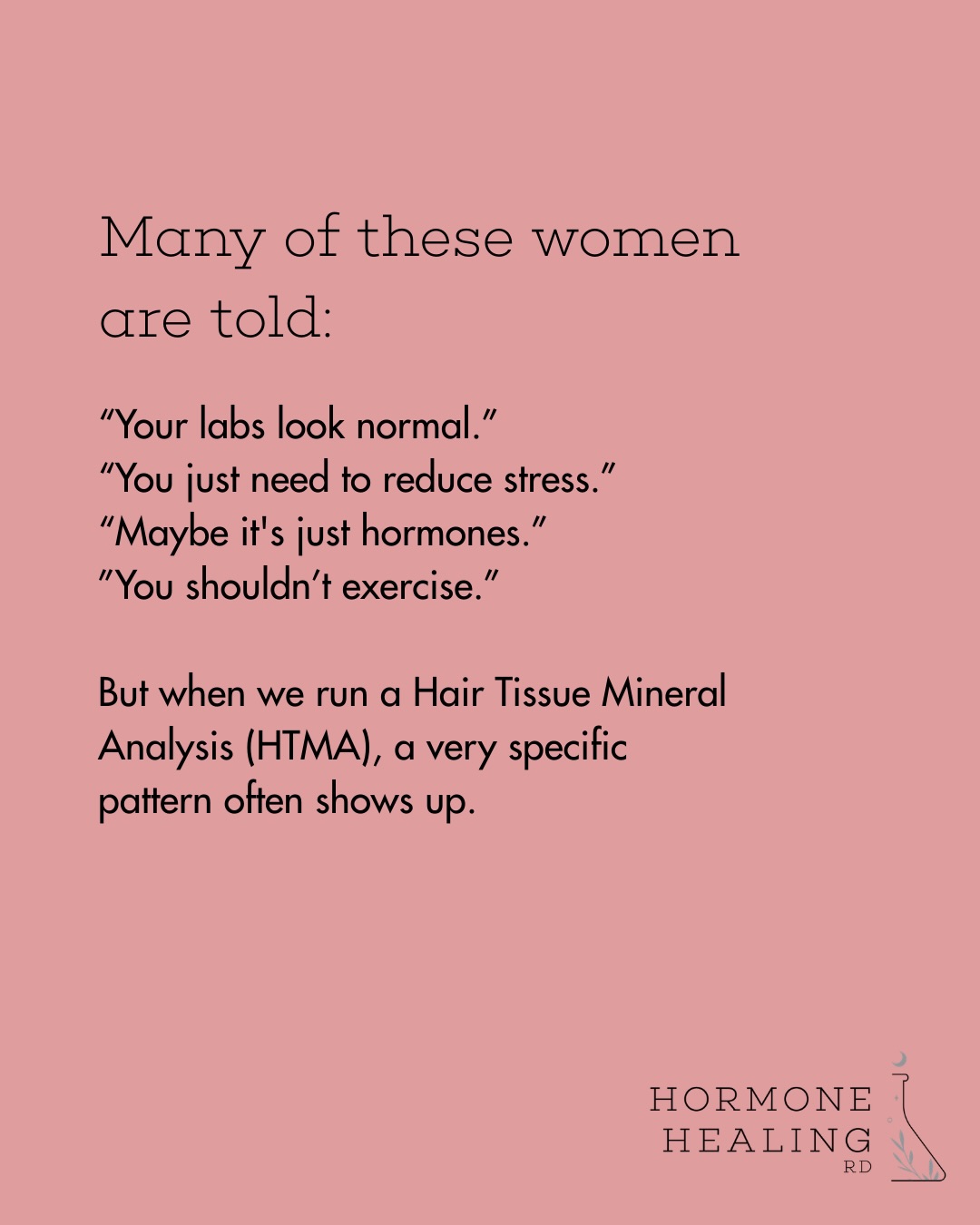
This one is called a Fast 4 (or Four Lows) pattern on HTMA, where the body’s first four minerals, calcium, magnesium, sodium, and potassium, are all depleted.




This one is called a Fast 4 (or Four Lows) pattern on HTMA, where the body’s first four minerals, calcium, magnesium, sodium, and potassium, are all depleted.
If parts of these patterns felt familiar, you are certainly not alone. This is exactly the type of deeper metabolic picture we explore inside the Mineral Healing Journey. Our next cohort begins at the end of May, and enrollment is opening to the waitlist now!
Because many women join several weeks before the program begins, we’ve created a Prep Program so you can start supporting your body right away.
Inside the prep program you’ll begin implementing:
• foundational nutrition shifts
• simple lifestyle changes that support your nervous system
• a beginner kettlebell program to ease into strength training
This gives you time to start building momentum before the program begins, and it also allows us to review your hair test and have your custom mineral blend ready when the program starts so you can begin immediately.